Theory of Light and Color

31. Exhibit Lighting in Museums and Art Galleries:
Low-Damage LED Lighting
In the last chapter (Chapter 30), we compared the features of various general lighting sources used in our everyday living spaces. This chapter will focus on the lighting used in museums and art galleries, which require higher quality and have different demands compared to typical daily-use lighting.
(1) Lighting for Viewing
Exhibit lighting is essential to creating the appropriate environment that allows viewers to appreciate the items on display. There are various considerations to determine the optimal lighting method depending on the type, shape, and size of the displays, the purpose of the exhibition, and the conditions of the exhibition room. For example, how does the color of the display appear due to lighting (color rendering), what color is the light source (correlated color temperature), what is the illuminance at a given position, from which direction to illuminate and from which direction to observe, which is better: direct lighting or indirect lighting, etc. All these factors create the best possible lighting setup for each exhibit.
(2) Damage by Lighting
Exhibit lighting in museums and art galleries isn't just about making it easy to appreciate. You might have noticed that the lighting in exhibition rooms is often quite dim and thought that brighter lighting would make it easier to see. In some cases, like with cultural artifacts, dim lighting can create a solemn atmosphere that enhances the viewer's experience.
While this is true, there's another very important reason for the dim lighting: to minimize light damage to the displayed objects. If you leave white paper in the sun for a long time, it turns yellow. The stronger and longer the light exposure, the more the paper discolors. This happens because prolonged light exposure damages the paper's molecules, altering their structure and reducing the paper's reflectance in the blue region of the visible spectrum. The same principle applies to museum and gallery lighting. To prevent damage, the lighting is kept as dim as possible.
Short-wavelength light, which has high-energy photons, tends to cause more damage to objects. Molecular damage not only changes the reflectance (leading to fading) but can also cause the object to become brittle and more prone to breakage. While changes in temperature and humidity can also influence this brittleness, the primary causes are UV-induced molecular damage and the thermal effects of infrared light. ≪1≫
Damage to displays is generally irreversible. Many items in museums and galleries are historically and culturally significant, and once damaged, they become irreparable. Therefore, careful lighting considerations are essential to preserving these valuable artifacts.
(3) Balancing Damage Prevention and Viewing Conditions for Exhibits
The susceptibility of exhibits to damage such as fading and brittleness from lighting depends largely on the material of the object. ≪2≫ From the lighting side, it greatly depends on the spectral irradiance distribution and exposure time. Since UV and IR light are not visible to the naked eye and do not enhance viewing, the principle is to use lighting that cuts out these wavelengths. However, sometimes this precaution is overlooked, so attention is needed.
On the other hand, the visible spectrum directly affects viewing conditions. Adequate brightness and color rendering are necessary for viewing, restoration, and management. Moreover, some objects may look better under lighting with a higher correlated color temperature (relatively stronger short-wavelength components), creating a conflict between damage prevention and viewing conditions.
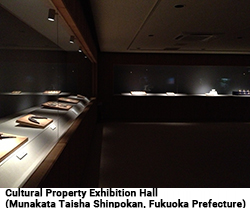
In practice, lighting needs to balance both aspects, but for historically valuable artifacts, damage prevention (preservation) tends to take priority. Consequently, low-damage fluorescent lamps with high color rendering properties are commonly used for valuable cultural artifacts, often with dim lighting that cuts out UV and IR.
Even within the visible spectrum, short wavelengths like violet and blue light can cause damage, though not as severely as UV light. Thus, dim lighting with a reddish hue (lower correlated color temperature) that minimizes short wavelengths is preferable. Exhibitions of cultural artifacts often limit the display period to a few weeks to minimize exposure to light. When not on display, these artifacts are kept in dark storage with temperature and humidity control to prevent damage.
(4) White LED Lighting for Exhibits
The trend of LED adoption has also expanded into museums and art galleries. While the same balance between viewing conditions and damage prevention applies to LED lighting, the unique features of LEDs have led to even better lighting solutions compared to the previously dominant low-damage, high-color-rendering incandescent and fluorescent lamps.
LEDs produce narrow-band, quasi-monochromatic light, which can minimize harmful UV and IR radiation without filters. In combination with phosphors, LEDs can emit only the visible spectrum needed for viewing with a smooth spectral distribution and extremely high color rendering. Additionally, specific phosphors can produce different light colors (correlated color temperatures). Leveraging these characteristics, CCS Inc. developed Natural Light LEDs (see Chapter 30), which are now being adopted in museums and galleries.
* For more information on Natural Light LEDs, please click here.
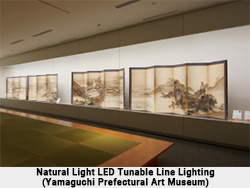
The high efficiency (low power consumption) and long lifespan of LEDs are significant advantages, just as they are in general lighting applications. Furthermore, unlike traditional light sources that use vacuum bulbs, LED lighting is more compact, offering greater flexibility in installation within exhibition rooms. Multiple white LED sources with different correlated color temperatures can also be incorporated into a single lighting fixture. By controlling the emission of each LED externally, the light color can be adjusted as needed. For instance, some exhibits now allow viewers to observe how the same item looks under morning, noon, and evening light, creating a more interesting viewing experience. ≪3≫
Comment
≪1≫ Various causes of damage to cultural properties
In museums, cultural properties must be preserved permanently without any damage. Although it does not apply to all types of exhibits, the causes of damage include temperature, humidity, mold, and pests, in addition to damage caused by lighting (the main topic here). For example, temperature changes can cause physical damage over time due to expansion and contraction, leading to brittleness. In some cases, spot lighting creates these temperature differences between illuminated and non-illuminated areas. Generally, the rate of chemical reactions doubles with every 10°C increase in temperature.
Humidity is also crucial. Low humidity can cause surface hardening, paint peeling, and cracking, especially in wooden objects. High humidity can promote the growth of bacteria and mold and cause rust or tarnish on metal surfaces. Additionally, pest damage (such as claw marks and feeding damage) and contamination from their droppings are serious concerns.
≪2≫ Material-dependent damage
Exhibits include a wide range of items such as paintings, manuscripts, textiles, leather goods, sculptures, ceramics, artifacts, and specimens of plants and animals. Even within a single category, like paintings, there are various types such as oil paintings, watercolors, and ink paintings, and susceptibility to environmental damage varies with the material.
When it comes to light damage, inorganic materials (like metal, glass, and stone) and organic materials (derived from plants and animals) generally show different responses, with organic materials typically being more susceptible. There is not always a clear separation between inorganic displays and organic displays, research suggests categorizing the light damage response into four categories (no response, low response, medium response, and high response) to manage preservation effectively.
≪3≫ LED lighting with variable correlated color temperature
The LED lighting installed at the Yamaguchi Prefectural Art Museum, manufactured by CCS Inc., includes adjustable light color, simulating the transition from morning to evening and showing how the appearance of artworks changes throughout the day. CCS's proprietary technology has a high color rendering index (CRI) of Ra 95 or above for all light colors while taking measures to prevent damage.