

Theory of Light and Color
30. Everyday Light Sources: Characteristics of General Lighting
The way colors appear depends on the characteristics of the lighting (spectral distribution). The general light sources used in our living spaces make objects look more natural (or pleasant). In the previous chapter, we introduced the CIE color rendering index as a widely used evaluation method based on the fidelity of color reproduction.
The lighting in our living spaces (generally referred to as white light sources) ranges from sunlight to various artificial light sources. Even sunlight, which might seem straightforward, varies significantly in its characteristics depending on the season, time of day, and weather conditions. When it comes to artificial light sources, some common ones include incandescent lamps, fluorescent lamps, mercury lamps, and LED lamps. Even within a single category like "fluorescent lamps," there are various colors available.
Given this wide variety of light sources, we use different types of lighting in our daily work and life based on the purpose and nature of our activities.
(1) Important characteristics in general lighting
Four key characteristics are important for general lighting lamps. Depending on the purpose and use of the lighting, the importance of these characteristics can vary.
[1] Color Temperature (Correlated Color Temperature)
[2] Color Rendering
[3] Lamp Efficiency
[4] Lamp Lifespan
Characteristics [1] and [2] affect how humans perceive color under a given light source.
[1] Color Temperature (Correlated Color Temperature): As discussed in Chapter 28, color temperature combined with brightness greatly influences the psychological atmosphere of the illuminated space. The choice of color temperature depends on whether you want a refreshing or calming ambiance.
[2] Color Rendering: This refers to how naturally (or favorably) objects appear under the light. This is crucial for lighting in living spaces to ensure that the colors of objects look as expected or desired.
Characteristics [3] and [4] are primarily economic considerations.
[3] Lamp Efficiency: This is measured by how much light (lumens) is produced per unit of power consumed (watts). It is expressed as lm/W. ≪1≫ The lower the efficiency, the more electricity is consumed to achieve the same brightness, leading to higher electricity bills. Additionally, if the lamp's lifespan is short, it needs to be replaced more frequently, increasing costs and effort.
[4] Lamp Lifespan: A longer lifespan means less costs and work needed to replace the light source. In recent years, characteristics [3] and [4] have also become important from an environmental perspective. Higher efficiency means less energy consumption for the same brightness, directly reducing carbon dioxide emissions. Shorter lifespans lead to more frequent replacements, increasing energy used in manufacturing and disposal.
The following is a comparison of common light sources based on the four characteristics mentioned above.
(2) Incandescent Lamps
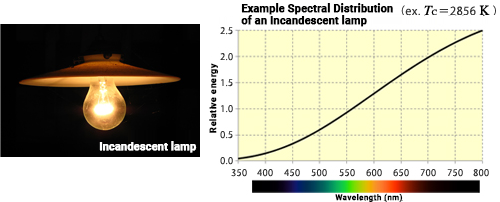
Invented and commercialized by Edison and Swan in the late 19th century, incandescent lamps have the longest history as electric artificial white light sources. These lamps are the quintessential thermal radiation-type light source, emitting light by heating a filament to a high temperature to produce a continuous spectrum. The principle behind this type of light emission, known as black body theory, was established by the German physicist Max Planck (see Chapter 27). The spectral distribution of incandescent lamps can be expressed as a function of absolute temperature using Planck's radiation formula.
Incandescent lamps have extremely high color rendering, meaning objects appear very natural under their light. Because of this, they are used as a standard light source in CIE color rendering. However, there are some disadvantages due to the nature of their light-emitting mechanism:
1) Achieving high color temperatures is difficult (limited to about 3,000 K).
2) They have large infrared components, resulting in low luminous efficiency. ≪2≫
3) The lifespan is short because the filament needs to be heated to high temperatures.
In recent years, the low efficiency of incandescent lamps has become a major issue, especially from the perspective of environmental protection. As a result, many manufacturers have stopped producing them, leading to a rapid decline in their usage.
(3) Halogen Lamps
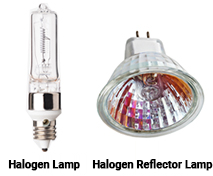
To address the shortcomings of incandescent bulbs, halogen lamps were developed by adding halogen gas inside the lamp. This addition helps reduce filament degradation and breakage caused by high temperatures. ≪3≫ The basic principle of light emission is the same as incandescent lamps, but halogen lamps can heat the filament to a higher temperature. As a result, halogen lamps can produce light with a higher color temperature than incandescent lamps (up to about 3,500 K), and their lifespan is about twice as long.
It has a continuous spectrum similar to the spectral distribution characteristics of incandescent lamps. ≪4≫ This means halogen lamps also have good color rendering properties. However, like incandescent lamps, the higher the color temperature, the shorter their lifespan.
(4) Fluorescent Lamps
One of the most familiar light sources in our daily life, fluorescent lamps emit visible light by exciting phosphors coated on the inner walls of the lamp with ultraviolet radiation produced by electrical discharge in a vacuum. (The ultraviolet radiation used to excite the phosphors is cut off to prevent it from leaking outside the lamp and causing harm.) By selecting and combining various fluorescent materials, the spectral distribution of the light can be altered to achieve a range of light colors (correlated color temperatures) from daylight to incandescent light (refer to Chapter 28).
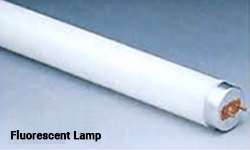
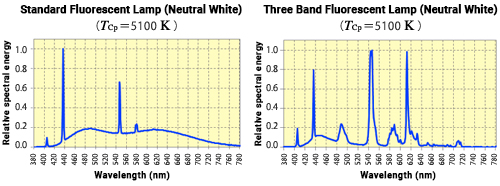
Fluorescent lamps are more efficient than incandescent and halogen lamps. When fluorescent lamps were first invented, they rapidly gained popularity because they cost about one-third as much in electricity bills compared to traditional incandescent lamps, and they also had a longer lifespan. However, the fluorescent lamps of that time had poor color rendering properties (with an average color rendering index (Ra) of about 60 to 70), meaning objects did not appear very natural under their light. (See Comment ≪2≫ in Chapter 29.)
Efforts were made to improve the color rendering of fluorescent lamps, but there was a dilemma: improving color rendering often led to decreased energy efficiency while increasing energy efficiency led to poorer color rendering. This problem was solved with the development of three-band fluorescent lamps, which have sharp emission spectra in the red, green, and blue wavelength regions. By selecting emission spectra that matched the characteristics of the three types of cone cells in the human eye, these lamps greatly improved color rendering without sacrificing efficiency, ≪5≫ and also enhanced the clarity of color perception.
(5) LED Lamps (White LED)
As described in Chapter 25, the invention of blue LEDs made white LED lighting possible, and it has rapidly spread in recent years. However, when white LEDs first hit the market, many people felt that colors looked unnatural under LED lighting. Despite the advantages of high efficiency (saving on electricity costs) and long lifespan, these LEDs were limited to specific uses and didn't become widespread for general lighting. ≪6≫
The conventional blue-YAG type white LED produces white light by emitting yellow fluorescence when excited by blue light. This combination of blue and yellow light creates white light. As shown in the figure on the right, the spectral distribution has significant peaks and troughs. The prominent peak of the blue excitation light (around 440 nm) and the areas with low energy distribution (highlighted by yellow arrows) make color rendering difficult.

Depending on the spectral reflection (transmission) characteristics of an object, this kind of spectral distribution can make the object's colors appear unnatural. Color rendering for red colors is particularly problematic, and the special color rendering index for R9 is often low, sometimes even less than 0.
Recent advancements have led to white LEDs that span the entire visible spectrum. By combining different phosphors, these LEDs can be made in various correlated color temperatures and have smoother spectral distributions closer to standard light sources, significantly improving color rendering. For example, the "Natural light LED" manufactured by CCS achieves both a high average color rendering index (Ra) and above 90 for all special color rendering indices Ri across all test colors (i = 1 to 15).
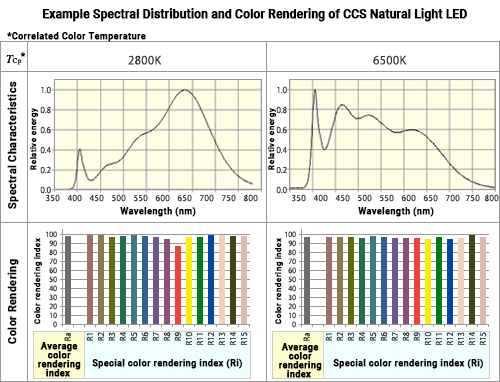
Furthermore, LEDs naturally emit light in a narrow spectrum without ultraviolet or infrared components, eliminating the need for filters to cut out unwanted wavelengths. This results in highly efficient visible light sources. ≪1≫ It is also possible to variably control the emission color with high-density LED configurations, so LED light sources are expanding into new applications.
(6) Sodium Lamps
A common light source used in tunnels is the low-pressure sodium lamp, which emits an orange light. Why are low-pressure sodium lamps, rarely used in our daily living spaces, often used for tunnel lighting?
Tunnels are filled with car exhaust, meaning numerous tiny particles float in the air. In this environment, the phenomenon of light scattering becomes a problem, specifically Rayleigh scattering. Rayleigh scattering is inversely proportional to the fourth power of the light’s wavelength, meaning shorter wavelengths scatter more easily. When tunnels are illuminated with white light containing all visible wavelengths, the short wavelengths scatter significantly due to the floating particles, making it look like the tunnel is filled with smoke and reducing visibility.
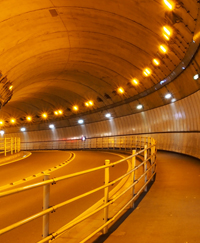
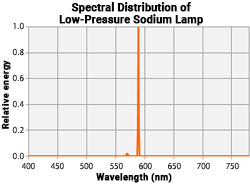
The spectral distribution of low-pressure sodium lamps is a line spectrum around 589 nm, known as the D-line, with almost no other wavelength components, giving it an orange appearance. This line is on the longer wavelength side of the visible spectrum, making it less prone to scattering and providing good visibility, which is crucial for safety in tunnels.
Additionally, there are significant economic reasons for using these lamps. They are highly efficient and have a long lifespan. Since tunnels need to be lit 24/7, high electricity costs are a concern. Even if color rendering isn't ideal, it is acceptable as drivers only pass through the tunnel for a short time. The longer the lamp life, the less frequently it needs replacing, which reduces maintenance costs (lamp price and replacement labor).
Recently, car engines have become more efficient, reducing exhaust gas concentrations. As a result, high-pressure sodium lamps and Hf fluorescent lamps, which provide white light, are gradually being used in place of the orange low-pressure sodium lamps.
Comment
≪1≫ Lamp efficiency (lm / W)
When we talk about "lamp efficiency," it’s important to understand that this term can have several definitions. The definition used depends on how we evaluate the energy consumption to achieve the "visible brightness" that humans perceive. Here are some ways to define lamp efficiency:
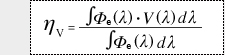
1) Luminous efficiency of radiation ηv
This is the ratio of the total luminous flux (lm) within the visible range to the total radiant flux (W) emitted by the lamp, including ultraviolet, visible, and infrared radiation. This measure evaluates the proportion of emitted energy that contributes to visible brightness, disregarding the power consumed and heat generated by the lamp. For a perfect ultraviolet or infrared source, ηv would be 0, as none of the emitted energy contributes to visible brightness.
2) Luminous efficiency of a lamp unit ηP1
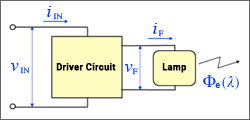
This is the ratio of the total luminous flux (lm) emitted by the lamp to the power consumed by the lamp alone (W), excluding the power consumed by the driver circuit. If the lamp generates a lot of heat, ηP1 will be lower.

3) Luminous efficiency of a lamp and auxiliary equipment ηP2
This is the ratio of the total luminous flux (lm) emitted by the lamp to the total power consumed by both the lamp and its driver circuit (W). If both the lamp and the circuit consume a lot of power, ηP2 will be lower.

For the same lamp, comparing these three efficiencies shows that as the scope of power consumption increases, the efficiency value decreases. Therefore, ηv > ηP1 > ηP2.
Given the increasing focus on environmental protection, it’s essential to consider the "total efficiency" (ηP2). However, since the power consumption of the driver circuit can vary widely depending on the application, it’s often more practical to compare the "lamp unit" efficiency (ηP1).
These definitions are not applicable when the function of a lamp is not to provide visible brightness (e.g., UV curing lamps).
≪2≫ Power efficiency of incandescent lamps and halogen lamps
For thermal radiation light sources like incandescent and halogen lamps, a significant amount of energy is distributed in the infrared region, leading to low luminous efficiency (ηv). As much of the input power is expended as heat, the lamp unit efficiency (ηP1) and the total efficiency (ηP2) are also low.
≪3≫ Halogen cycle
In incandescent lamps, tungsten atoms evaporate from the filament at high temperatures, which causes the filament to thin and the bulb’s interior to blacken, eventually leading to a break. By adding halogen gas to the lamp, the evaporated tungsten atoms combine with halogen atoms to form tungsten halide, which circulates within the lamp. When the tungsten halide approaches the hot filament, it decomposes back into tungsten and halogen, redepositing tungsten onto the filament. This halogen cycle prevents filament thinning and bulb blackening, extending the lamp’s life.
≪4≫ Halogen lamps with reflectors
Some halogen lamps are equipped with reflectors that transmit infrared and reflect visible light or have filters that cut infrared. These modifications improve lamp efficiency. Although their spectral distribution in the visible long-wavelength range differs slightly from incandescent lamps, their color rendering is nearly identical.
≪5≫ Color rendering of three-band fluorescent lamps
To be classified as a three-band fluorescent lamp, the color rendering index (Ra) must be 80 or higher (JIS Z 9112:2012).
≪6≫ Initial investment issues with LED lamps
When LED lamps were first introduced, despite lower operating costs, the initial investment was high. This meant it took longer to recoup the initial costs, limiting their widespread adoption. This issue has improved over time.
Everyday Light Sources:
Characteristics of General Lighting