

Theory of Light and Color

40. Gloss
In everyday conversation, when talking about objects with smooth, shiny surfaces that reflect light, like a porcelain teacup, a glass tumbler, or a metal container, one way to describe them is "glossy." On the other hand, objects like paper or chalk have no sense of gloss at all. No matter which direction the light comes from or which angle you view them from, the appearance changes very little. So, what exactly is this phenomenon we call "gloss"?
(1) Distribution Characteristics of Reflected Light
We see gloss when the positions of the light source, the object, and the observer are such that the object's surface is viewed from the direction of the specular reflection (regular reflection) of light coming from the source. If you view it from a direction away from the specular reflection, the surface will appear less glossy. In fact, the stronger the glossiness of the reflecting surface, the darker it will appear from that off-angle.
When an object's surface is illuminated from a certain direction, how much of the incident light is reflected in each direction—the light distribution characteristics of reflected light—is deeply related to the perception of gloss.
In figure (c), specular reflection (regular reflection) is exactly what occurs with a mirror surface: for an incident light ray with an incident angle θi, the reflected light travels in a direction symmetric to the surface normal, with a reflection angle θr equal to θi.
In figure (a), perfect (Lambertian) diffuse reflection produces the greatest reflected luminous flux in the surface normal direction (θr = 0°), regardless of the incident angle θi. In all other directions, the reflected flux decreases in proportion to the cosine of the reflection angle (cos θr) relative to the normal direction (See Chapter 9).
The light distribution characteristics of reflected light lie between these two extremes of specular reflection (c) and perfect diffuse reflection (a). On most real surfaces, reflection is like figure (b): the reflection is strongest in the specular direction (θr = θi) and gradually becomes weaker as you move away from it. For a single narrow incident light ray, specular reflection (c) concentrates the reflected light energy entirely into the reflection angle direction, making the surface appear extremely bright from that direction. From any other angle, almost no light enters the eye, making it appear completely dark.
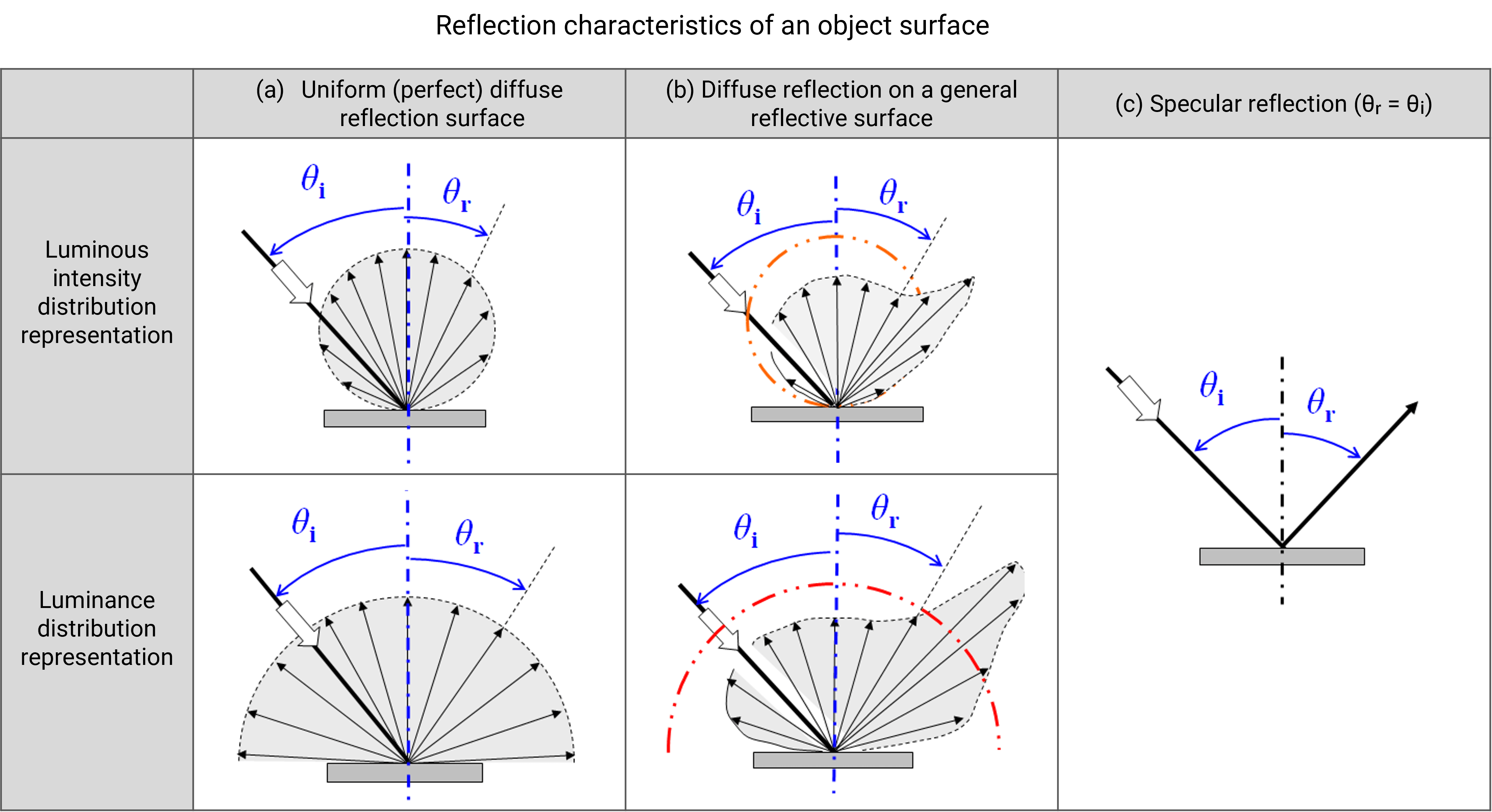
Now, what about perfect diffuse reflection (a), such as white paper or chalk? When discussing diffuse reflection characteristics (light distribution), as shown in the top row of the figure, it is often illustrated through luminous intensity distribution, which shows how the luminous flux per unit solid angle changes with reflection direction. From this diagram, it's tempting to assume that directions with low intensity will appear dark, and those with high intensity will appear bright. But this is not exactly correct.
As explained in Chapters 9 and 10, the human perception of surface brightness is based not on luminous intensity, but on luminance—the light intensity per apparent unit area. Therefore, when discussing gloss, it is better to look at the luminance distribution shown in the bottom row.
For perfect diffuse reflection, the luminous intensity of the reflected light changes with cos θr depending on the viewing direction, but so does the apparent unit area. These two factors cancel each other out, making the luminance distribution constant regardless of viewing direction (See Chapter 9). This is why surfaces like paper or chalk, which have nearly perfect diffuse reflection characteristics, appear to have almost no gloss.
On a typical reflective surface (figure (b)), the stronger the reflection in the specular direction, the greater the luminance in that direction compared to other directions, increasing the sense of gloss. In other words, the strength of the reflection component in the specular direction directly determines the degree of gloss.
(2) Factors that Determine Distribution Characteristics of Reflected Light
The factors that influence the distribution of reflected light include:
1. The direction of the incident light relative to the reflecting surface
2. The degree of fine surface texture (whether it is rough or smooth)
3. The relationship between the object's internal material structure and the wavelength of the incident light
Distribution characteristics result from a complex interplay of these factors. First, regarding the direction of illumination: If the reflecting surface is perfectly smooth, the light will be reflected specularly (θr = θi). Depending on the combination of the incident light's wavelength and the object's composition, some portion of the incident light may penetrate the object instead of being reflected. As described later, it is then absorbed or scattered by the object's internal structure. This reduces the overall reflectance. Generally, the reflectance increases as the incident angle θi becomes larger (shallower illumination angles), so glossiness tends to be stronger when the illumination comes from a shallower angle.
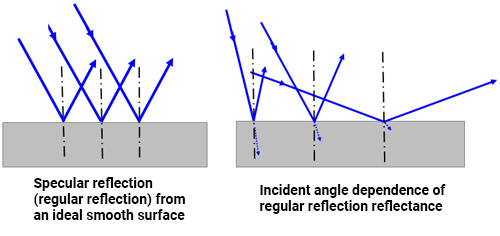
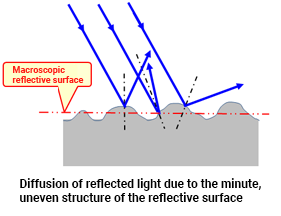
In most real-world objects, the reflecting surface is not perfectly smooth but has fine surface irregularities, resulting in more complex reflection. The smoother the surface (more polished), the closer its reflection characteristics are to those of a flat mirror, increasing the proportion of specular reflection. When the surface is rough, even if the overall surface is illuminated with parallel light at a fixed angle, each tiny area of the surface has a slightly different orientation, and the local angle of incidence varies from point to point. The direction of each microscopic specular reflection will vary, causing the overall (macroscopic) reflection distribution to diffuse around the main specular reflection angle.
Another factor influencing diffuse reflection is the scattering and absorption that occur inside the object due to the interaction between the material's molecules/atoms and the incident light. As explained in Chapter 32, light that enters the material without being reflected at the surface is repeatedly scattered by the densely packed molecules and atoms, changing direction many times. During this process, some of the light is absorbed by the material, but part of it is re-emitted back toward the incident side, combining with the light reflected at the surface.
Both scattering and absorption generally have wavelength dependence. As a result, the spectral distribution of diffuse reflection re-emitted from inside the object often differs from that of the incident light. This is why objects have color under white-light illumination.
For surfaces with strong gloss, the proportion of specular reflection is large, and the diffuse reflection emitted in the specular direction from inside the material is weak. This means that the spectral distribution in the specular direction closely matches that of the light source. While the non-glossy parts of the surface appear colored, the glossy highlights themselves have little to no apparent color.
(3) Measuring Gloss (Specular Glossiness)
As explained above, the light distribution characteristics of reflected light are determined by a complex combination of various factors. In simple terms, the degree of gloss is determined by the strength of specular reflection at the object's surface. The challenge lies in how to make objective and quantitative comparisons and evaluations.
There are many factors to consider when evaluating the gloss of a reflecting surface, such as the positional relationship between the light source, the reflecting surface, and the observer; the magnitude and range of the incident angle; and the spectral properties of both the light source and the reflecting surface. These conditions must be clearly defined to compare and evaluate gloss.
For example, when the light source has a large emitting area, the incident light on the reflecting surface will include many different angles of incidence. Some of the specular reflection will enter the eye, and gloss will be perceived from many different positions on the surface and observation angles. In such cases, the reflectance (luminance factor) changes depending on the angle of incidence, meaning that the intensity of the specular reflection—the perceived gloss—varies with observation angle. Furthermore, the combination of the light source's spectral distribution and the object's spectral reflectance (spectral luminance factor) will change the spectral distribution of the reflected light, altering the brightness perceived by the human eye.
The method for measuring and evaluating glossiness is defined in the Japanese Industrial Standard (JIS). JIS Z 8741-1997 "Specular glossiness -- Method of measurement" specifies that glossiness should be measured using an optical setup like the one shown in the diagram at the lower right.
In this setup, the optical axes of the illumination lenses L1 and L2 are aligned to the desired incident angle θi. The rays from the light source pass through aperture S1 and hit the sample's reflective surface at θi. The specularly reflected luminous flux is captured by lens L3 and passes through aperture S2 to the photodetector. In this configuration, aperture S1 is positioned at the focal point of lens L1, so the sample surface is illuminated with nearly parallel light. Lens L3 captures the specular reflection and forms an image of aperture S1 at the position of aperture S2. This arrangement ensures that all specular reflection passes through to the photodetector, while diffuse reflection is blocked at S2.
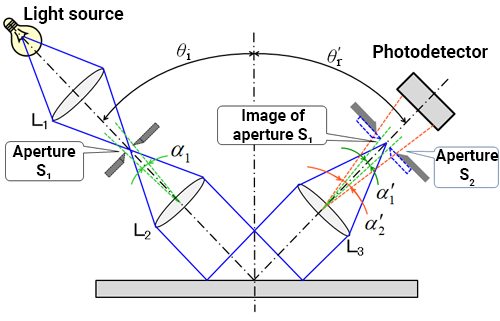
With this measurement system, the sample's reflective surface is illuminated with nearly parallel light (divergence angle α1) at the incident angle θi, and the photodetector captures the specular reflection, which also has a narrow divergence angle α1′. ≪1≫
The standard specifies five possible incident angles (θi): 85°, 75°, 60°, 45°, and 20°. Because reflectance generally increases with larger incident angles, this allows the selection of an appropriate incident angle depending on the material, application, and other conditions.
The reference standard for specular glossiness is a smooth glass surface with a refractive index of n = 1.567 over the entire visible wavelength range. For each incident angle θi, the specular reflectance ρ0 (θi) of this reference surface is specified.
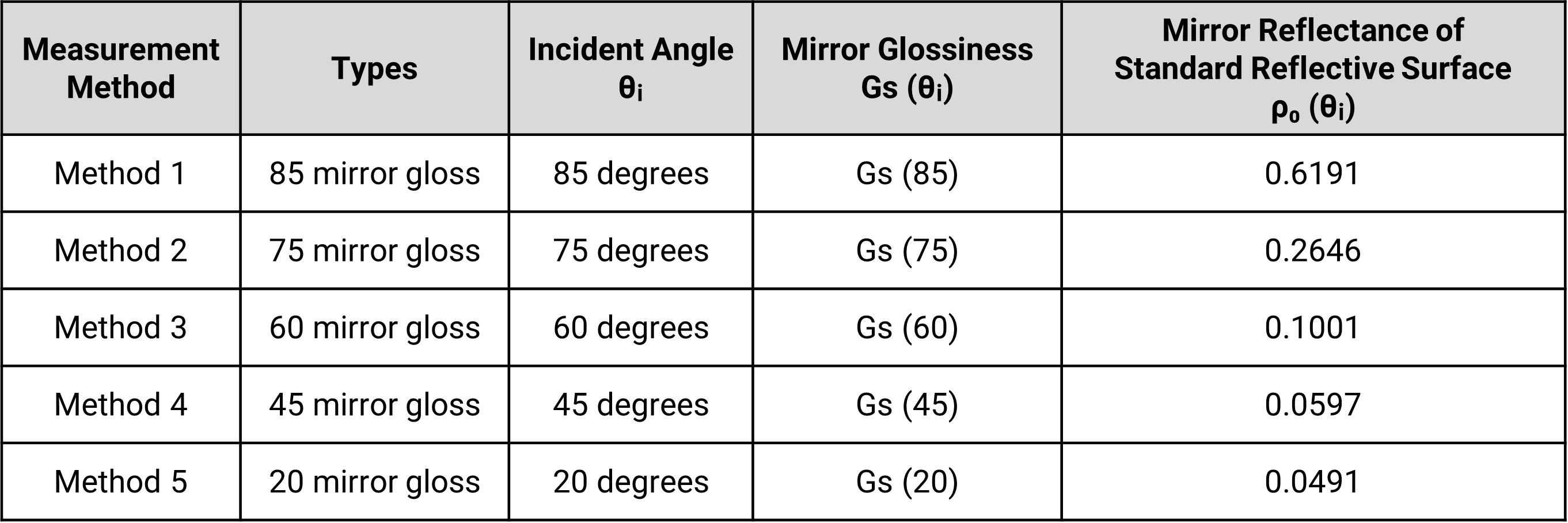
If φ0S is the specularly reflected luminous flux from the reference surface at the specified θi, and φS is the measured value from the sample surface under the same conditions, then the sample's specular glossiness GS (θi) is defined as follows, with the glossiness of the reference surface set to G0S (θi) = 100%:
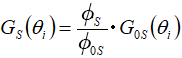
At each incident angle condition, the glossiness of the reference surface is defined as G0S (θi) = 100%, and the sample's specular glossiness (in %) is expressed as the relative ratio to this reference.
The light source used must be non-polarized ≪2≫, and the combination of the light source and detector must have spectral characteristics equivalent to the combination of standard illuminant D65 and the standard spectral luminous efficiency function V(λ).
In practice, gloss meters come with standard gloss plates (working standard surfaces) for instrument calibration. These plates are supplied with glossiness values calibrated against the primary reference surface described above. Measurements of sample gloss are calculated using these reference values and the formula above. Because the glossiness of working standard plates can change over time due to dirt or wear, periodic recalibration is recommended.
This is the JIS-specified method for measuring specular glossiness. While the brightness perceived by the human eye from a reflective surface should ideally be evaluated in terms of luminance (i.e., luminous intensity per unit apparent area), the JIS measurement system actually says to measure the reflected luminous flux φ from the surface.
In this system, as shown in the measurement diagram, the detector observes the reflecting surface from an oblique direction through aperture S2. If the reflection angle θr (= θi) is fixed, then both the "measurement solid angle" and the "apparent area of the reflecting surface" remain fixed. Therefore, even though the measured output is in terms of luminous flux φ, it effectively has the dimensions of luminance. Since the light source and detector characteristics are also fixed, luminous intensity I = dφ / dΩ and luminance L = dI / (dA · cos θr) = dφ / (dΩ · dA · cos θr) both become directly proportional to the measured luminous flux φ.
Thus, by measuring the luminous flux φ in the specular reflection direction through aperture S2 and calculating the reflectance relative to the reference surface, it is possible to determine the luminance ratio to the reference surface—i.e., the specular glossiness—without having to measure luminance directly, using a simpler measurement system.
Comment
≪1≫ About apertures S1 and S2
In the JIS specification, apertures S1 and S2 are described as rectangular. However, here the explanation has been simplified to convey the main idea.
≪2≫ Reflectance in the case of polarized light
If the light source is polarized, the reflectance's dependence on the angle of incidence will behave differently for each polarization component (s-polarization and p-polarization). This can cause problems when measuring specular gloss.