

Theory of Light and Color

37. Metamerism
(1) What Does "Color Match" Really Mean?
As explained in Chapter 12, the perceived color of an object is determined by the interaction of three key factors: light, the object, and the visual system (the eyes and brain). Specifically, it is the result of the combination of the spectral distribution of the light source, the object's spectral reflectance (or transmittance) properties, and the response characteristics of the visual system's three types of cones. Generally, if any of these three factors change, the perceived color also changes.
For instance, an object's color will appear different under sunlight compared to warm-white fluorescent lighting. When switching the light source shining on two objects, both objects' colors will shift based on the properties of the new light. However, there are cases where two objects might appear the same color under one light source (Light A) but different under another light source (Light B).
Imagine buying a belt and handbag in matching colors at a department store. However, they look slightly different in color when you step outside during the day. In this case, the belt and handbag have different spectral reflectance properties due to their differing materials, leading to this mismatch.
However, they both happen to look the same if the belt's spectral reflectance ρ1 (λ) and the handbag's spectral reflectance ρ2 (λ) have a particular relationship with the spectral distribution P (λ) of the light source (in this example, the lighting of the department store).
The same concept applies to light sources themselves. If two light sources, A and B, have different spectral distributions, denoted as PA (λ) and PB (λ), they are typically perceived as different colors. However, under the right conditions, the visual system may perceive the two lights as the same color even if PA (λ) ≠ PB (λ). This principle underlies the CIE (International Commission on Illumination) color-matching experiments described in Chapter 24. Even though the spectral distributions differ, the experiments show they can look identical when their interaction with the visual system creates the same cone responses.

In general, when the spectral distributions of two stimuli entering the eye are identical, they are recognized as the same color. This phenomenon is known as perfect color matching (isomerism or isomeric color match). For example, if two objects have identical spectral reflectance or transmittance properties, any changes in the light source's spectral distribution will affect both objects equally. Thus, they will always appear the same color relative to each other.
However, even if the spectral distributions of the stimuli are not identical, their interaction with the visual system—specifically the responses of the three types of cones—may lead to identical cone response values. When this happens, the two stimuli are perceived as the same color. This phenomenon is called conditional metamerism (metamerism or metameric color match).
Conditional metamerism arises due to the complex interplay between the spectral properties of light and objects and the unique sensitivity of the human visual system. The three types of cone cells in the retina have different spectral sensitivities. When the spectral distribution of two stimuli combines with the cones' responses to produce identical signals, the brain interprets them as the same color—even if their spectral distributions differ.
This phenomenon highlights the intricate relationship between the physical properties of light and objects and the subjective experience of color. Conditional metamerism is a crucial concept in industries like textiles, printing, and design, where ensuring consistent color perception across various lighting conditions is essential.
(2) The Three Elements of Color and Tristimulus Values (X, Y, Z)
When discussing the three elements of color—light, object, and vision— this discussion will focus on vision, specifically by considering it in the context of a standard observer and within the realm of color sensation. ≪1≫ According to the CIE color system, the color sensation perceived in response to external light stimuli can be expressed using three tristimulus values: X, Y, and Z.
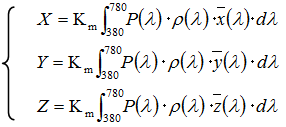
Km: Maximum luminous efficiency (Km = 683 lm / W)
P (λ): Spectral distribution of the light source
ρ (λ): Spectral reflectance/transmittance of the object
For light source color ρ(λ) = 1
 : Color matching functions
This formula defines the color sensation quantitatively based on the interaction of the three elements of color: light, object, and vision. The color is determined by the relative proportions of the tristimulus values, expressed as X:Y:Z. (See Chapter 23.)
As the formula shows, if the spectral distribution of the light source P(λ) or the spectral reflectance of the object ρ(λ) changes, the tristimulus values (X, Y, Z) will also change. Consequently, the perceived color will shift.
・Variation in light source properties: If the characteristics of the illuminating light P(λ) differ, the same object will appear to have a different color.
・Variation in object properties: Similarly, even under the same light source, if the object's properties ρ(λ) differ, the color will change.
In essence, the interaction between the spectral characteristics of light and objects determines the final color the human visual system perceives.
(3) Illuminant Metamerism
Consider two objects with spectral reflectance properties ρ1 (λ) and ρ2 (λ). When observed under a light source with a spectral distribution P (λ), the tristimulus values representing the colors of these objects, (X1, Y1, Z1) and (X2, Y2, Z2), can be expressed as:
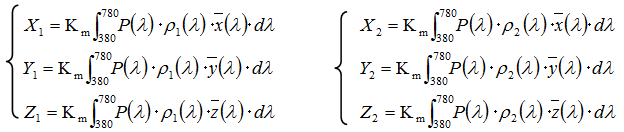
If (X1, Y1, Z1) = (X2, Y2, Z2), the objects are perceived as the same color. If not, the differences ΔX, ΔY, ΔZ represent the cause of the color difference:
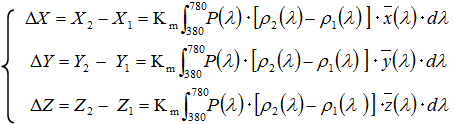
If the spectral reflectance characteristics of both objects are identical, as in ρ1 (λ) = ρ2 (λ) across the entire visible spectrum (380 to 780 nm), then ΔX = ΔY = ΔZ = 0, meaning the two objects will always appear the same color (complete isomerism), regardless of the light source P(λ). This can be immediately understood from the equations above.
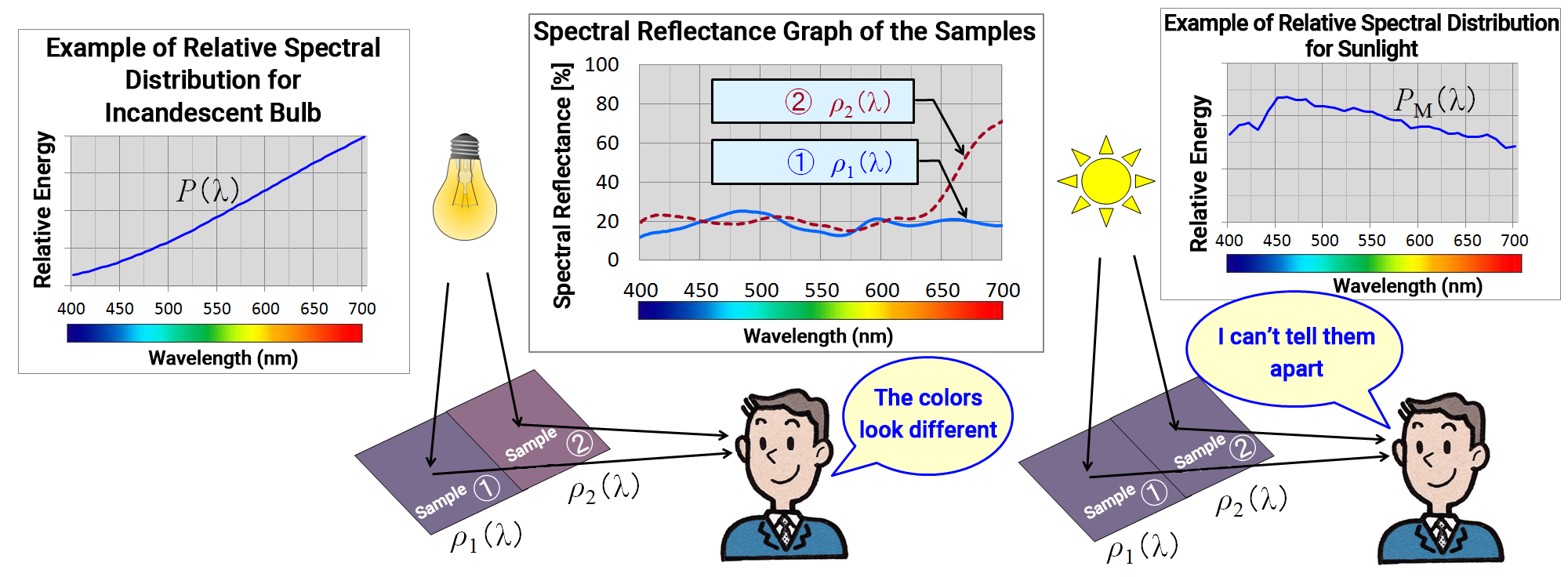
However, ΔX = ΔY = ΔZ = 0 can occur even if the spectral reflectance properties ρ1 (λ) ≠ ρ2 (λ). When ρ1 (λ) and ρ2 (λ) differ, there can exist a special spectral distribution of light, PM (λ), such that the contributions of positive and negative factors cancel out across the visible spectrum. This happens when the reflectance curves ρ1 (λ) and ρ2 (λ) intersect at three or more wavelengths. In such cases, the integral across the visible spectrum can result in ΔX = ΔY = ΔZ = 0, causing the two objects to appear the same color under PM (λ). This is the mathematical explanation of metamerism under different illuminants.
The diagram below illustrates this phenomenon: two objects that appear as different colors under a general illuminant like incandescent light P (λ) may appear as the same color under daylight with a specific spectral distribution PM (λ), such as sunlight with a correlated color temperature of 6,500 K. This phenomenon, where two objects that look different under one light source appear the same under another, is called illuminant metamerism.
(4) Object-Color Metamerism
When the spectral distribution of illumination P(λ) is fixed, various objects with different spectral reflectance properties ρ1 (λ), ρ2 (λ), ρ3 (λ), generally appear as distinct colors. However, under this fixed illumination, there are specific combinations of spectral reflectance properties ρi (λ) and ρMj (λ), where ρi
In such cases, even though the spectral reflectance properties are not identical, the colors of two objects look the same under the light source. In contrast to illuminant metamerism, this phenomenon is known as object-color metamerism.
(5) Geometric Metamerism
Geometric metamerism refers to a phenomenon where the color of two objects changes when viewed from different directions, even under the same lighting conditions. The same phenomenon can occur when the viewing direction is the same, but the lighting direction changes. This happens with materials whose spectral reflectance properties change depending on the angles of incidence and reflection at the object's surface. ≪2≫
In such cases, the spectral reflectance characteristics of the materials, ρ1 (λ) and ρ2 (λ), vary based on the viewing or illumination angles. Under these conditions, within the visible spectrum, the relative magnitude of ρ1 (λ) and ρ2 (λ) can reverse at certain wavelengths. Even if the spectral distribution of the light source P (λ) is fixed, the integral values for different wavelength ranges can cancel each other out. As a result, the overall integral values for the visible spectrum may equal zero, leading to ΔX = ΔY = ΔZ = 0, meaning the two objects are perceived as the same color (metamerism). This is called geometric metamerism because it depends on the geometric relationship between the light source, observation directions, and the object's surface properties.
For illuminant metamerism, object-color metamerism, or geometric metamerism, the principle is that if the spectral distribution of color stimuli entering the eye is identical, the colors will match. However, the reverse is not necessarily true: just because colors match does not mean that the spectral distribution of the stimuli is identical. This distinction underscores the complexity of metamerism.
(6) Observer Metamerism
So far, the discussion has assumed a standard observer with representative visual characteristics. However, individual differences in vision mean that metameric functions vary from person to person. In practice, this means that under specific observation conditions, one observer may perceive two colors as identical (metameric), while another perceives them as different.
If the color-matching function of Observer A is xA(λ), yA(λ), zA(λ) and that of Observer B is xB(λ), yB(λ), zB(λ), the tristimulus values for their color perception, (XA, YA, ZA) and (XB, YB, ZB), can be expressed as:
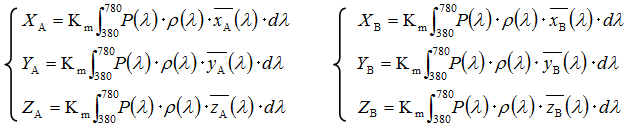
The difference in color perception between Observer A and Observer B (ΔX, ΔY, ΔZ) is given by:
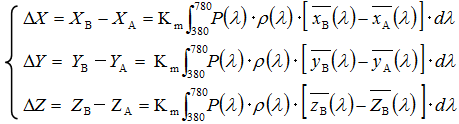
If Observer A and Observer B have identical visual characteristics (i.e., their metameric functions are identical), the difference becomes ΔX = ΔY = ΔZ = 0. This means they perceive the same color. However, if their visual characteristics differ, the tristimulus values will generally not be equal, resulting in differing color perceptions. In certain cases, even if the metameric functions xA (λ), yA (λ), zA (λ) and xB (λ), yB (λ), zB (λ) differ, they may align in such a way that ΔX = ΔY = ΔZ = 0. In such instances, both observers perceive the same color. This phenomenon is referred to as observer metamerism.
Unfortunately, it is challenging to directly confirm differences in color perception between individuals due to the subjective nature of visual sensations. However, in cases where Observer A has normal color vision, and Observer B has significant color vision deficiencies, we can indirectly verify differences in color perception.
For example, individuals with dichromatic vision cannot distinguish between certain colors that lie along confusion lines on the xy-chromaticity diagram. Colors along these lines appear identical for such individuals, even if those with normal color vision can distinguish them. This is an extreme example of observer metamerism. (See Chapter 14)
(7) Field-Size Metamerism
Typically, observer metamerism refers to conditional metamerism caused by individual differences in color vision characteristics among different people. However, there are instances where observer metamerism occurs within the same person.
It is well known that the perceived color of a sample can change subtly depending on the size of the area the sample occupies in the field of view (referred to as the area effect). (See Chapter 24 Comment ≪2≫). This phenomenon arises because the human retina has slightly different color perception characteristics in the macula, where cone cells are densely concentrated, and the surrounding areas, where cone density is lower. ≪3≫ As a result, when the same person observes a color sample of different sizes (i.e., different visual angles), the area of the image formed on the retina changes, leading to slight differences in perceived color even under the same lighting conditions.
Because of this, when observing two similar colors that are technically different, changing the size (or angular size) of one of the samples can make it difficult to distinguish between them. While the spectral distribution of light entering the eye does not depend on the sample's size, the area effect, caused by the retinal cone distribution structure, leads to conditional metamerism known as field-size metamerism.
(8) The Role of Metamerism in Everyday Life
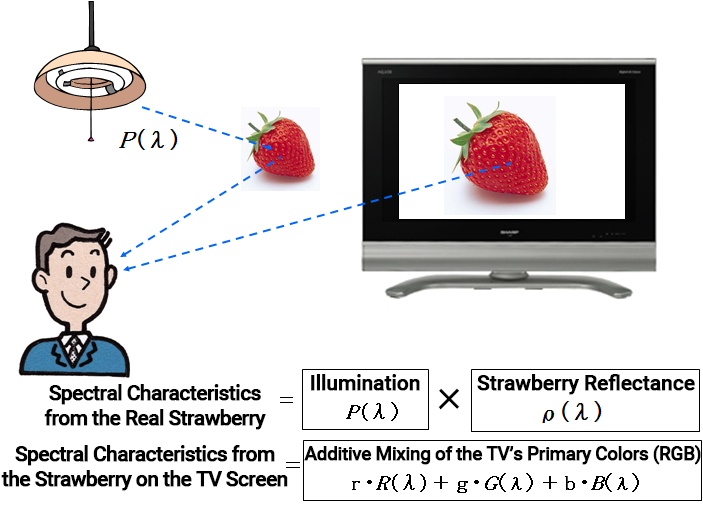
The phenomenon of metamerism has significantly broadened how we use "color" in various aspects of human life. For example, an image of a strawberry on a screen or in a photo is entirely different from a real strawberry. Yet, we see the color as identical to the red of a real strawberry.
The spectral distribution of light entering the eye from an actual strawberry differs from that of a strawberry displayed on a TV or in a photograph. The strawberry on a TV screen is created through additive color mixing using the three primary colors of light: red (R), green (G), and blue (B). Meanwhile, the strawberry in a photograph is reproduced through subtractive color mixing using yellow (Y), magenta (M), and cyan (C). Although the spectral distributions of the actual strawberry and its reproductions differ, metamerism allows us to perceive them as identical colors. The ability to create a wide variety of colors using additive or subtractive color mixing is rooted in the principle of metamerism.
As discussed in Chapter 30, tri-phosphor fluorescent lamps have achieved wide adoption by significantly improving color rendering without sacrificing lamp efficiency. Unlike incandescent bulbs or daylight, the spectral distribution has extremely sharp emission lines. While light sources with line spectra, such as mercury or sodium lamps, often have poor color rendering, tri-phosphor fluorescent lamps achieve high color rendering.
The reason lies in illuminant metamerism and how the spectral reflectance curves of metameric color pairs intersect at several wavelengths within the visible range, with their relative magnitudes reversing at different wavelength regions. These intersection points of spectral reflectance curves tend to be near the peak sensitivity wavelengths of human visual perception (L, M, and S cones). By tuning the emission wavelengths of line spectra to these points, tri-band phosphor fluorescent lamps can easily induce metamerism while also enhancing the cone stimulus values (X, Y, Z). This optimization is how tri-phosphor fluorescent lamps achieve high levels of color rendering performance and lamp efficiency.
Despite the prevalence of color images on TVs, photographs, and light sources like tri-phosphor fluorescent lamps that rely on metamerism, it's important to recognize that metameric color-matching does not apply universally to all individuals. Some people may perceive colors differently due to observer metamerism. This is often overlooked but is especially relevant from a color accessibility perspective, particularly for individuals with color vision deficiencies. Raising awareness of these differences is crucial in promoting color barrier-free design and accessibility.
Comment
≪1≫ Color sensory response quantities
Among the three key elements of an object's color (light, object, and vision), the light illuminating the object can be described objectively and quantitatively through spectral distribution. Similarly, the object can be characterized using spectral reflectance (or transmittance) properties. However, the vision element involves complex physiological and psychological factors, making it extremely difficult to describe objectively or quantitatively.
If we divide the visual process into two stages—color sensation and perception—the color sensation stage tends to exhibit a clearer correlation between physical color stimuli and psychological responses. This correspondence can be described as a psychophysical quantity, which expresses the characteristics of color sensation. The CIE color space's tristimulus values (X, Y, Z) can be considered as quantities representing color sensory response.
≪2≫ Angle dependence of spectral reflectance
The angle dependence of spectral reflectance, which causes geometric metamerism, often arises from the orientation of particles, such as pigments or additives, incorporated during the manufacturing process of a material. These particle orientations can create variations in reflectance, depending on the angles of incidence and reflection.
≪3≫ The macula and cone distribution
The macula, which covers the central fovea where cones are densely distributed, derives its name from its yellowish, membrane-like structure. The cone cells distributed within the macula receive light stimuli through a yellow filter. Consequently, the spectral sensitivity of the cones in the macula differs slightly compared to cones outside the macula. This difference contributes to the variation in the color-matching functions of the CIE color space for 2° fields (focused, central vision) and 10° fields (broader, peripheral vision).